


Railway Chai Wala


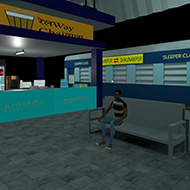
What actually happens once the last train of the night pulls away from Fakripur and Ramu is still standing at his stall? That’s the question most players carry into Railway Chai Wala, and it’s a fair one, because the game spends real effort making sure you feel that emptiness before anything strange announces itself.
A Stall That Never Really Stops
Railway Chai Wala opens with Ramu mid-shift, chai already on the boil, samosas already frying, passengers already forming a line. There’s no framing device easing you into the mechanics; you’re just working, the way Ramu presumably has been for years at this same corner of the platform.
The core loop covers four things: brewing chai and coffee, frying samosas, preparing vada pav, and pouring Kokila Kola for passengers who want something cold instead. Each item takes a slightly different amount of attention, and balancing three or four requests at once is the entire early challenge.
It sounds mundane written out like that, and for a while, it is. That’s deliberate.
Meeting Fakripur’s Regular Faces
The passengers aren’t interchangeable. Some show up daily with the same order, some linger to talk, some behave in ways that feel just slightly off once you’ve been paying attention for a while. Railway Chai Wala uses these repeat faces to build familiarity with the station before quietly undercutting it.
Players who gravitate toward narrative-driven experiences tend to name this as the strongest part of the game, since the writing leans on specific, small details rather than generic horror dialogue. A passenger who asks the same question every morning becomes noticeably unsettling the one time the question changes.
This is also where the game asks the most patience of you. Conversations can’t be rushed without losing the texture that makes the later turn land.
Chai Brewing and Order Timing in Railway Chai Wala
Mechanically, chai is the anchor task. It has to steep, which gives you a window to handle samosas or vada pav orders in parallel, and misjudging that window is the most common way beginners fall behind. Coffee behaves similarly but on a shorter timer, which trips up players who assume the two drinks work identically.
Cola requires no preparation at all, which makes it the easiest order to fall back on when the counter gets crowded, but leaning on it too heavily means neglecting the chai and coffee orders that carry more weight with certain passengers.
- Start chai brewing the moment a passenger orders it, since the steep time is the longest in the loop
- Use the brewing window to knock out quick cola or vada pav requests
- Save coffee for when the counter is calmer, since its shorter timer punishes multitasking
How Difficulty Shifts as the Shift Goes On
There’s no scoring system pushing you to fail stall tasks, so the difficulty curve in Railway Chai Wala isn’t mechanical, it’s tonal. Early shifts are busy but safe. Once the platform starts emptying out and the ambient sound design changes, the same walk between the stall and the platform edge feels like a different kind of task entirely.
This is the section of the game most closely tied to its horror label, and it’s also the most divisive. Some players find the shift genuinely tense, praising how it never resorts to a jump scare to make its point. Others feel the horror elements stay too restrained and would have preferred the game commit harder to the unsettling turn once it arrives. Both reactions show up regularly in discussions.
What Beginners Consistently Miss
New players tend to treat every scene the same way: serve fast, move on. That works for the first stretch and actively works against you later, once the game starts rewarding attention over speed. Passengers stop being obstacles to clear and start being the actual content worth paying attention to.
The other common miss is skipping ambient details around the platform itself. Fakripur station has background elements that shift subtly over the course of the story, and players focused purely on the counter tend to reach the ending without noticing half of what changed around them.
Community Vocabulary Around the Game
Discussion threads around Railway Chai Wala tend to describe it using terms borrowed from the broader walking-sim horror space: slow-burn, cozy-horror-that-isn’t-really-cozy, and comparisons to other everyday-setting horror titles come up constantly. It’s telling that even players who found it more funny than frightening still describe finishing it in one sitting without checking the clock.
What is the twist in Railway Chai Wala about?
Without spoiling specifics, it centers on details Ramu starts noticing among the regular passengers at Fakripur station, and how the station’s routine isn’t quite as fixed as it first appears. The game builds toward this gradually rather than revealing it in one scene.
Does Railway Chai Wala have jump scares?
Not in the traditional sense. Its tension comes from atmosphere and dialogue shifting around familiar tasks rather than sudden scripted frights, which is part of why player reactions to its horror label are mixed.
Is there more than one ending?
The story follows a linear structure focused on Ramu’s specific experience at the stall, so it’s built around a single defined arc rather than branching outcomes tied to serving choices.
Whatever you make of the horror label, Railway Chai Wala earns its reputation the same way Ramu earns his regulars: one quiet, unremarkable shift at a time, until Fakripur station stops feeling quite so unremarkable.